Showing posts with label Kirstenbosch. Show all posts

Wednesday, June 24, 2015

Face painting @ Moyo

Moyo @ Kirstenbosch
I like to take visitors to Moyo, a restaurant which serves Pan-African heritage foods including many of my favorite South African dishes like Bobotie, Potjie, and Malva Pudding.

There are currently five Moyo restaurants in South Africa: one at Blouberg and at Kirstenbosch Botanical Gardens in Cape Town; at Melrose Arch and Zoo Lake in Johannesburg; and at Ushaka Marine World in Durban. The restaurants are fun and festive and they have great gift shops!


We had lunch at the Moyo in Kirstenbosch

One of the things that makes Moyo so festive is their face painting ritual. Hey, you don't have to be a kid to like face painting!


Friday, June 5, 2015

Smelt

all photos of me by Marguerite Slavik

Another fun and creative outing in Joburg. This time, glass blowing and casting paperweights at Smelt located in The Factory on Grant in Norwood.

We had a choice between glass blowing or casting our paperweight. I chose ... both!


trying on the tools of the trade

Safety is numero uno at Smelt with amateurs like me. Only one person at a time could be in the glass-blowing zone. So after an overview of safety precautions and a description of the process, we each took a turn in the hot seat. Our workshop leaders Mike and Thabiso did all the heavy lifting. I just did what I was told. It's safer that way!


rolling the molten glass in the cobalt glass glitter
shaping the round paperweight
In between, those of us who opted to sand cast a paperweight created our form into which the molten glass was poured. We could add decorations such as colored glass rods, colored glass glitter, and copper cut-outs or wire.

the sand mold ...
... is filled with the molten glass
 The next day ...
... they were done.
hot out of the oven
our sand cast paperweights ready for pick up
Mandela's Gold

My sand cast paperweight with five slender glass rods captured inside. (Credit goes to Marguerite for the idea of using the colors of the South African flag in her paperweight.) Some people thought it looked like a bird-of-paradise. I can see it. In that case I will call it Mandela's Gold, a special bird-of-paradise cultivated by Kirstenbosch Botanical Garden, which coincidentally also has the colors of the South African Flag..
The Sardine Run


I am calling this paperweight The Sardine Run. Not because it was my inspiration before making it, but because that was my first thought when I saw it coming out of the kiln. It looked like a bait ball of sardines to me. It will make a perfect Father's Day present for Vince who will be spending Father's Day weekend diving in the Sardine Run!


This was a private workshop but Smelt offers weekly workshops on Saturdays and Sundays which are open to the general public. Just sign up.

Smelt also has art glass pieces, vases and plates crafted by professional glass artists on display and for sale and they will gladly take commissions.

Monday, March 9, 2015

We picked a bad day to go to the top of Table Mountain!

cable car up to the top of Table Mountan
March 3rd was the hottest day on record in Cape Town. Ever. In fact, on March 3rd Cape Town was the hottest place on Earth.

According to timeanddate.com, at a whopping 42 degrees Celsius, Cape Town was officially the hottest city on the planet. That's right! Hotter than Bangkok, Accra and Dar es Salaam. Hotter than Dubai, Riyadh and Doha!

Cape Town officially the hottest place on earth!
the papers said to drink plenty of fluids; Cher was happy to oblige


42 degrees Celsius is about 108 degrees Fahrenheit! And some people we spoke to told us their thermometers registered more like 45 degrees. Even hotter!


And we knew it too the minute we arrived on the top of Table Mountain. Usually - even in summer - I have to throw on a light windbreaker or sweater. It's windy up there. But even with the wind, it was hot. At 8:00 in the morning!

no jacket needed on top of Table Mountain!
After Table Mountain, we headed over to Kirstenbosch for a stroll. Even in the shade it was hot.


Kirstenbosch felt like a fireball!

The fireball lilies were in bloom!

The next day we were back to a pleasant high of 27 degrees. Perfect weather for a visit to the Cape Winelands.


Monday, February 16, 2015

Tour of Olifantsfontein

Vince and I joined the Archaeological Society of South Africa on a tour of Olifansfontein near Pretoria. Led by Professor Alex Duffy, the talk and tour focused on the history of the ceramic pottery industry which flourished in this area. The highlight of the tour was an opportunity to visit the house and gardens of Sunlawns at Olifantsfontein, the home of Roland Cullinan who was the founder of the Ceramic Studio and the Linnware Studio.


Mistress of Sunlawns Pauline Cullinan with Professor Duffy and the resident pets
Professor Alex Duffey is an Art Historian, who completed his PhD in History of Art at the University of Pretoria in 1982. He became Professor in Art History in 1984 and lectured at the University of Pretoria until his retirement in 2012. He has published extensively on South African art, Chinese ceramics and Ancient trade with southern Africa, for which he received the Stals Prize from the South African Academy of Science and arts in 2010.


Professor Duffy brought an example of Transvaal Pottery creamware


First, a little background. Sir Thomas Cullinan (of Cullinan diamond fame) started a pottery at Olifantsfontein called the Transvaal Pottery in 1905. He imported potters from England and they produced a variety of household crockery until 1914, when the pottery closed. Sherds of this type of pottery are still found at archaeological sites that date to this era.


In 1924, Sir Thomas Cullinan's son, Roland Cullinan allowed three potters from Natal to start up a new pottery at Olifantsfontein called the Ceramic Studio. Between 1925 and 1942 they produced a variety of ceramic wares, including tile panels for Governmental Buildings and Post Offices in South Africa.

Roland Cullinan had the house Sunlawns built in 1931 and it houses every type of architectural pottery they produced, including examples of the many types of building bricks which the firm Conrand produced. In 1942 Conrand took over the Ceramic Studio and renamed it the Linnware Studio, which produced similar ceramics to those of the Ceramic Studio until 1962.  

Since Vince and I collect Linnware, we couldn't resist this rare opportunity to visit Sunlawns!

Irene Post Office
We met our group at the Irene Post Office which has a beautiful example of the ceramic tile mosaic panels produced by the Ceramic Studio. According to Professor Duffy, there are only about 100 examples left in South Africa and they are very vulnerable to destruction and decay. They are seriously in need of some kind of heritage protection.

The building was erected in a typical Department of Public Works style with the emphasis on using only South African materials where possible. The post office was completed in 1940.


ceramic tableau on the side of the post office

The extraordinary ceramic tile tableau depicts the Symbolic Ossewatrek's in Pretoria on 16 December 1938. It was painted by Rose Hope.

Since it was a Sunday, we couldn't go inside the post office but Professor Duffy told us that in the entrance hall there are tiles similar to Delft Blue. The tiles portray Van der Bijl as well as various historical buildings from the Western Cape like Tokai and Groot Constantia.


We were allowed to wander freely around the first floor and gardens and see the details Professor Duffy described during his talk.


the patio had many ceramic jars and flower boxes
 The Cape Dutch house was designed by Vivian Sydney Rees-Poole ...

the roof tiles were all made with Transvaal clay


The drawing room ...

Relief panel on lower portion of large sloping hood over fireplace

the relief  depicts the people of South Africa

Boers and Zulus

Bushmen, Xhosa and Englishmen

ceramic fanlights


ceramic switchplates


The hallways ...
the staircase riser tiles with depictions if Kirstenbosch flora

detail of the riser tiles
ceramic umbrella stand
The kitchen and skullery ...

the kitchen stove


The dining room ...


 The first floor bathroom ...

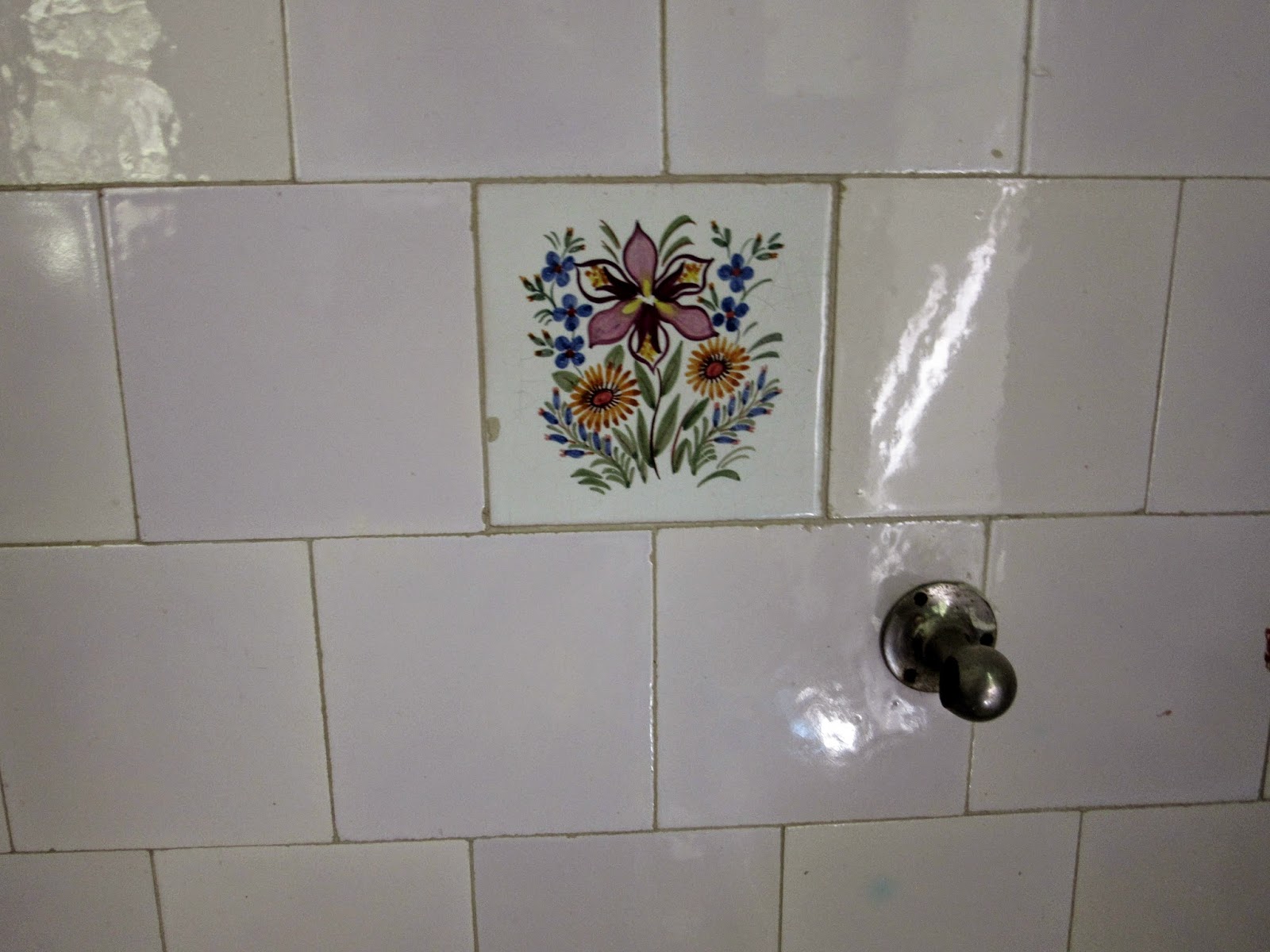
more Kirstenbosch tiles
ceramic mirror


pretty ceramic switchplate

The gardens were designed by Gertrude Jeckyll ...


Patio brickwork with the local clay brick factory stamp ...


Professor Duffy has just completed a new comprehensive book on the pottery of Olifantsfontein. It is at the publisher now. We have a copy of the first seminal work on the uniquely South African ceramic pottery which we bought at Collector's Treasury. We're looking forward to Professor Duffy's book launch soon!