Showing posts with label Past Experiences. Show all posts

Thursday, April 16, 2015

Chappie

Chappie is a science fiction film written and directed by Joburg native Neil Blomkamp. (Neil also wrote and directed District 9 and Elysium.) The movie stars Sharlto Copley, Sigourney Weaver, Hugh Jackman and Dev Patel.

Neil's work - much of it filmed in Johannesburg - is a kind of social commentary using science fiction as its vehicle for expression. District 9 (2009) was a singular anti-Apartheid metaphor, and Elysium (2013) is a more general metaphor about immigration and how the First World and Third World meet.  

Chappie is set in the near future where crime is patrolled by a mechanized police force. When one police droid, Chappie, is stolen and given new programming, he becomes the first robot with the ability to think and feel for himself.

According to Blomkamp, Chappie is more comedic satire than his other work. I have not seen it yet but my Computer Animator son in California has. Alex was surprised when I told him the inside joke surrounding the name "Chappie." (I never surprise him with my fun facts, so it was pretty cool to be able to it this time!)

Chappies is a brand of bubblegum introduced in South-Africa in the late 1940s. Chappies was created by Arthur Ginsburg while working for Chapelat, a Johannesburg-based confectionery manufacturer, as a competitor for the well established Wicks bubblegum.

The innovations of Arthur Ginsburg launched the Chappies brand into a position where the name Chappies became synonymous with the word bubblegum. (Like Kleenex and "tissues" in the USA or  Google and "search" the world over.)

The first innovation was the business model. While the Wicks branded gum was sold for 1c per piece, the smaller Chappies gum was sold at 1c for two pieces. This led to Chappies gaining value as currency as shopkeepers would give change in the form of gum. I remember my Past Experiences guide Jo Buitendach telling me the same thing. She grew up on Chappies and hands them out to the little kids she encounters while touring the CBD with her clients.

The second innovation was the inclusion of "Did you know" trivia on the inside of the wrappers. (Sounds like our Bazooka bubblegum growing up in the USA.)

Chappies was sold to Cadbury's many years ago, but they still maintain a nostalgic place amongst Joburgers - clearly including Neil Blomkamp.

Thursday, October 23, 2014

Joburg Graffiti

graffiti by Lord Byron on the Temple of Poseidon at Cape Sounion
Graffiti is almost as old as the hills they were first scratched on. Seriously, we saw ancient Crusader graffiti at the Church of the Holy Sepulcher in Jerusalem and some on the ancient temples of Greece. We even saw evidence of pre-volcanic eruption graffiti in Pompeii!

Kilroy was at the Washington Monument in DC
With World War II came what was probably the first viral American graffiti, "Kilroy was here," a favorite of my father's and Vince's. And speaking of Vince, we even have examples of Berlin Wall graffiti at home. Vince happened to be working in Berlin just as the wall was coming down between east and west. We dashed over with a hammer and chisel and joined the throngs who were slowly dismantling the graffiti-covered wall - on the west side anyway. Vince chipped away about a dozen pieces to bring home as souvenirs and as gifts for our WWII veteran relatives. Our son Alex even brought a piece to school that year for show and tell. He thought Vince has single-handedly brought the wall down and told his classmates so!

Most people once equated graffiti with vandalism on subways and derelict buildings and graffiti's association with the hip hop and skateboarding cultures of the inner cities. Or the political underground posted handbills espousing revolution and counter-culture messages. Défense d'afficher (Post No Bills).


Banksy in London

But somewhere, sometime pre-Banksy, graffiti became elevated to art. You can probably thank Keith Haring, and Basquiat for that. And you better thank Andy Warhol too.


See?

As you can imagine, with the derelict buildings of post-apartheid Johannesburg and a police force that has more important things to worry about downtown, graffiti took a foothold on the CBD. And out of  the ordinary defacing and messages of unrest have emerged a rich graffiti art culture and movement. Really sometimes it's hard to tell the difference between legal and illegal graffiti in Joburg, between the unsanctioned street and the commissioned public art like Freddie Sam's mural of the Boxing Mandela.

graffiti skateboard park
According to Bias, our graffiti-artist-turned-tour-guide for our Past Experiences Graffiti Tour, there are about 30 very active and recognizable graffiti artists in Joburg's overall estimated graffiti community of about 200. And that doesn't even  include the ones that fly in from Europe and Australia to participate in graffiti events such as the annual Return to the City night in Newtown. The more established artists usually belong to a crew and there are about 4 or 5 well-established and recognized crews in Joburg. Bias himself belongs to the OWN crew. (That's a crew, not a gang for all you SNL aficionados!)

tags by Mars, one of Joburg's more famous graffiti artists


We concentrated our walking tour in Newtown, the epicenter of the graffiti art scene in the Joburg CBD.


a piece by Bias


Bias "reading" the graffiti piece for us. That's a B


"Graffiti"is a pretty broad term that incorporates many materials and methods. Most of the time when we think of graffiti, we think of spray paint and markers. But there is so much more ...


stencil graffiti

wheatpasting by Madhatter
stencil by Fin
graffiti window

Some of the artists even incorporate the architecture of the buildings into their art.


Diaz's graffiti door


Back to the City graffiti on support pillars in Newtown

the WOW crew with tour guides Bias and Bones
on to a graffiti workshop @ Two by Two
Jonnie made these great garbage bag smocks for us. Thanks Mom!
first we drew our tag and bubble

We started small. Very small.


Juliet (aka FIN) demonstrates some spray paint techniques
and we throw it up! (not my terminology)
my crew tag
an ol' lady trying to look "street." so sad!
our WOW crew piece photographed by Cathy Barcroft
D-squared was here

Saturday, November 30, 2013

Going to See The Golden Rhino

I first heard about the Golden Rhino of Mapungubwe while on a JoburgPlaces walking tour of the CBD during the Joburg City Festival and I blogged about it after a subsequent Past Experiences walking tour of the mining district. Both tours walked by the much larger replica erected in front of the Standard Bank building which was formerly the site of the Cullinan Building. I knew I had to see the original someday as well as the archaeological site where it was originally excavated.

Step one achieved! Ros and I took the Gautrain to Pretoria to see the Mapungubwe Collection housed in the Old Arts Building on the campus of the University of Pretoria. As you can imagine, the capital city's university campus is huge with a typical mix of heritage buildings and more modern structures. Thankfully, Ros had called ahead to find out which of the many campus entrances was closest to the Old Arts Building.

We took the train from Sandton to Hartfield which is the end of the Pretoria line, one stop after the Pretoria CBD. It was a very short walk to the campus and after a minimum of fumbling we found ourselves at the Mapungubwe Museum. No pictures allowed!

The collection is housed in one large room. Displays on the perimeter walls tell the story of the expedition and excavation, the discovery of the civilization remains, and the culture of the people who inhabited Mapungubwe so long ago.

There was a display about the trade beads made of ivory and 24K gold which the local people would trade for goods from Asia. Interspersed between displays were collections of solid gold beaded necklaces, bracelets and anklets, golden scepters and vessels. There was a video monitor which I would imagine gives voice to the story of the discovery, but unfortunately it wasn't working. There was also a pretty large collection of gold fragments that belonged to one young boy. Lucky boy!

In the center of the room, the Golden Rhino ... and it was amazing. The Golden Rhino is about palm-sized. I wanted to take a picture of it with my palm as comparison, but did I mention, no pictures allowed! It is very detailed. Eyes, cute little ears and a jointed tail. And of course a horn. In their own display cases, also in the middle of the room, were a golden feline and a golden bovine. Not quite as finely crafted as the rhino - but still magnificent. By comparison, they really gave you an appreciation of the artistry and workmanship of the rhino's sculptor.

As we were leaving the campus we met an Arts Masters student who told us that the small collection on display is only a small fraction of the treasure unearthed at Mapungubwe. She told us the University is building a new state-of-the-art museum to display the full collection as well as the rest of the University's vast bequeathed art collection. Good news!

Monday, October 14, 2013

Art Deco Joburg

I have always loved the Roaring Twenties, the Jazz Age and Art Deco.
wearing 20's vintage in college


I love the spirit of the bright young things of the time,


Great Gatsby Dinner Dance at Mantoloking Yacht Club


their attitude and lust for life, ...


Jazz Age Lawn Party on Governor's Island, NY


their whimsy and freedom, ...


close-up of my butterfly cloche


their style.


Chrysler Building, NYC


Not surprising since I grew up amongst the finest collection of Art Deco architecture in the world.


But I was however quite surprised when on a Past Experiences walking tour recently through downtown Joburg, the tour guide made the claim that Johannesburg has the third-largest number of Art Deco buildings of any city in the world. What? I had never equated Johannesburg or South Africa with Art Deco. New York, Miami, Paris, Chicago, yes. But Joburg? While not an Art Deco architecture tour, she still managed to point out several buildings we passed along the way to begin to substantiate her claim.

And later on when I did the math, I read that Johannesburg had a huge growth spurt during the 20's and 30's that coincided with the emergence of the Art Deco movement. According to an article in the Christian Science Monitor, "The Art Deco buildings of Johannesburg, its suburbs, and the nearby city of Springs are monuments to one of the greatest boom times in South African history - the 1930s. It was during this decade that the price of gold skyrocketed, and lifted this country - and this city founded by gold-miners - out of the Great Depression. The construction boom that ensued saw skyscrapers rivaling those in New York spring from South Africa's dry veld grassland."

The Chamber of Mines

"Art Deco in Johannesburg, writes Frederico Fresch in De Arte magazine, "served to create for this dusty - if rapidly expanding - town in one of the farthest reaches of the empire ... a sense of wealth and glamour." The South African architecture expert says the "would-be sophistication" was meant to "counteract the incipient provincialism associated with a colonial city."


Many of these buildings are luckily protected by heritage and architectural trusts. And many have the coveted Blue Plaque designation. I have not seen an exclusive Art Deco walking tour offered by any of the local walking tour companies, but I plan to put together my own version and visit as many as I can as I move about town. First stop, the Astor Mansions.

And they are not just in the CBD. Outside the city, there are also a number of suburbs which have original Art Deco buildings. Yeoville,  Parktown, Greenside and Killarney to name a few. And then there's the Springs central business center in Sedibeng, home to a large collection of Art Deco structures with a total of 34 buildings! In fact, it claims to have the second largest number of small scale Art Deco buildings after Miami. One of its Art Deco gems is the Central Fire Station built in 1938. 

I found out that Rand Airport in Germiston, Ekhuruleni, was where part of the Amelia Earhart Story was filmed by the Moonlighting Film Production Services. The movie starred Hilary Swank as Earhart and Richard Gere as her husband George Putman. Rand Airport, which was shot to be both the Miami and Burbank airports, was selected because its art deco look and feel resembled those airports in the 1930s. The terminal building has remained virtually the same since it was built. 

Johannesburg continues to surprise me!

(PP: Post this posting I did find an exclusively art deco walking tour of the CBD put on by the Johannesburg Heritage Foundation. It was perfect!)

Sunday, October 13, 2013

The Golden Rhino


In front of the Standard Bank building in the CBD is a large-scale replica of the Golden Rhino excavated in a burial site at Mapungubwe. The real rhino sculpture is apparently much smaller than this replica and is made of pure gold.

Mapungubwe is a World Heritage Site about four hours north of Joburg on the Zimbabwe border and it is high on our list of planned long weekend trips. I want to do an archaeological tour of the site and I also want to see the actual Golden Rhino itself housed in Pretoria at the University of Pretoria Museum.

I will surely blog about it when I do, but in the meantime, there is a shocking story about the public disclosure of its discovery I want to share.

Jo 

Mapungubwe is considered by archaeologists to be the very first complex ancient society in Africa. The kingdom lasted from about 1075 to around 1220 AD.

According to Past Experiences founder, tour guide and real life archaeologist Jo Buitendach, a complex ancient society is one that has a king and a class system.


 The kingdom of Mapungubwe was one of the earliest examples of sacred leadership where the king had god-like powers and infallibility. The complex class hierarchy was comprised of specialized craftsmen and artists, farmers and an established trade society. There is archaeological evidence that the kingdom of Mapungubwe even traded gold and ivory with Asia.

Now here comes the interesting part. Since its discovery in 1932 this Iron Age site has been excavated by the University of Pretoria. However, the findings were kept from public attention until 1993, just prior to South Africa's first democratic elections! Why? Because evidence of a highly advanced indigenous society existing centuries before European colonialism spread across Africa ran contrary to the racist ideology of apartheid. The discovery of the Golden Rhino in particular disproved the propagated  fallacies that gold was a European discovery and that the skills necessary to mine, process and craft it into something as extraordinary as the golden figure of a rhino are too highly advanced for native Africans.

Shocking!

Saturday, October 12, 2013

Ka-ching


Bull and Bear sculpture

Today I went on another walking tour of the Joburg CBD. This time it was the Past Experiences Ka-ching Tour.

Mining. Money. Ka-ching. Here are some highlights ...


The "new" Standard Bank hanging building replaced the Edwardian era Cullinan building in the late 60's. A plinth from the old building stands in as an entry arch.


The Standard Bank "hanging" building. A revolutionary method of construction at the time, it was built by "hanging" each floor from the building frame from the top floor down to the bottom.


a goldmine stamp mill. If it could talk, it would say "Ka-ching."


the heritage plaque for the Ten Stamp Mill.

The Chamber of Mines


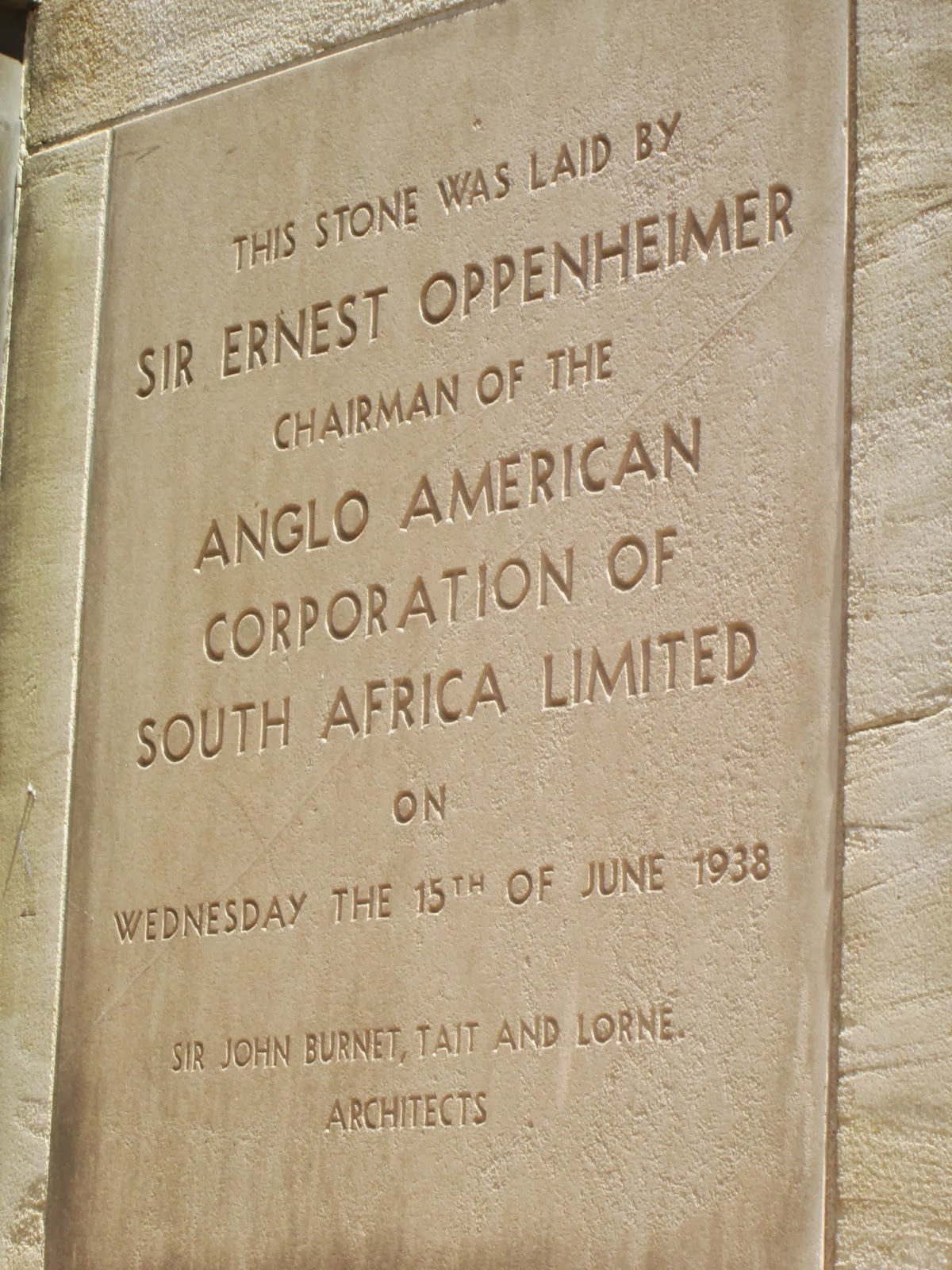
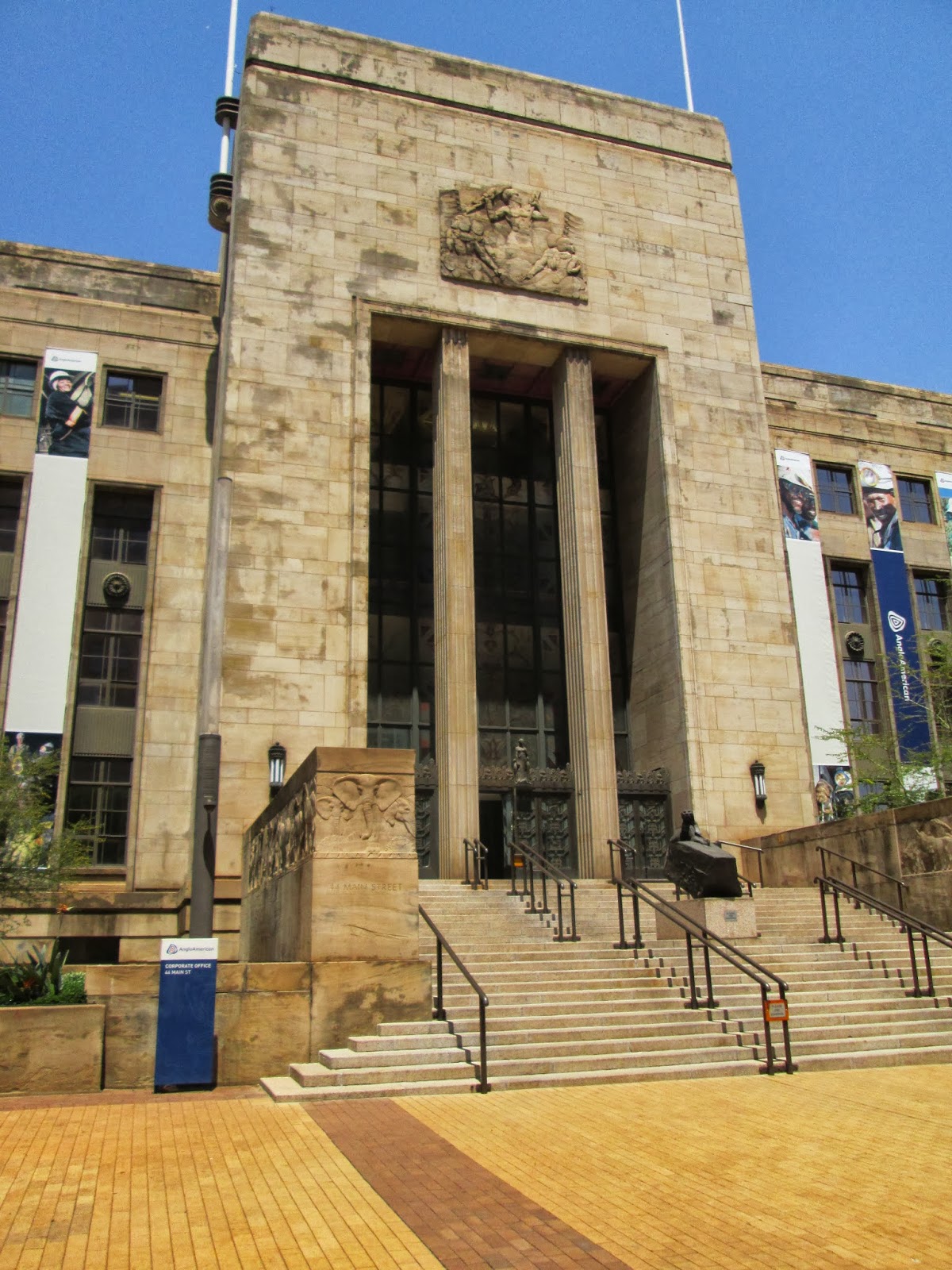
The Anglo-American Headquarters building


impressive art deco architecture

very Mussolini


24 karat gold lettering


public art everywhere. some new, some repurposed.


old mining head gear as art installation.


the first Standard Bank building downtown.