On January 13th, two Kariega rangers witnessed the birth of Thandi's baby girl at 8:50 a.m. Dr. William Fowlds, the veterinarian who saved Thandi's life, observed mom
and baby shortly afterwards and Dr. Fowlds confirms they're doing well.
Their area is off-limits to visitors so Thandi and her baby can be
undisturbed and give her calf the best chance of survival.
Dr.
Fowlds, of Investec Rhino Lifeline, says, “I am sure that the whole
rhino caring community will share in the joy of this amazing birth.
Thandi’s story has always been an incredible testimony of the will to
survive against all odds. She represents so much of what her species
faces under the current poaching crisis. Her survival has already given
us inspiration but the birth of her calf brings a new dimension of hope
to the crisis showing us that a future generation of life is possible if
we put our minds and hearts to it.”
Wildlife photographer and
filmmaker Adrian Steirn arrived at Kariega Game Reserve and
was able to capture photos and video of Thandi and her calf immediately
after the birth. He said, "Thandi's story has captivated the world
since she became a beacon of hope in the fight against rhino poaching.
To see her with a beautiful, healthy calf is truly a privilege and
should inspire optimism and renewed commitment to protect these
incredible creatures."
CONGRATULATIONS to dear Thandi, Kariega Game Reserve, and Dr. Fowlds on
the joyous birth of a healthy calf for Thandi!
We changed banks in South Africa from Standard Bank to Investec. We left Standard Bank because ... they suck. Vince chose Investec because they do not charge withdrawal fees no matter what bank ATM you use and he can do his foreign exchange online as opposed to having to schlep into a private account branch every time he wants to transfer funds to the US. Investec has no branches. It is a completely virtual banking facility.
I supported his decision to go with Investec because they in turn are a huge supporter of rhino conservation in Africa through their Investec Rhino Lifeline. From the Investec website: "South Africa is losing rhino daily, through poaching. It is the most significant conservation issue faced by the country and time is running out. In 2012 Investec established Investec Rhino Lifeline to respond to this crisis and has partnered with the Wilderness Foundation to achieve our goals. Our aim is to build awareness, raise funds, and support carefully selected education, rescue and prevention initiatives.
By working closely with our trusted partners and supporters, and by taking a hands-on approach, we believe that we can make a difference in saving the rhino and ensuring its long-term survival." And Investec Rhino Lifeline is the major supporter behind the work of Dr. William Fowlds:
"Dr William Fowlds is a qualified vet who dedicates his time to championing the plight of the rhino through his veterinary and awareness initiatives, while exposing the desperate reality of poaching attacks to the global media. He has been involved in conservation related activities, wildlife management, eco-tourism and intervention programmes to improve the quality of veterinary care for critically injured rhinos for over a decade. Apart from his South African veterinary network relating to wildlife, he has provided educational and training opportunities for students from vet schools representing all five continents to expose them to conservation issues within Southern Africa. Dr Fowlds also spearheaded educational safaris and television series highlighting the rhino crisis on NBC and ITV news, exposing the realities of poaching to the world, generating media awareness of this crisis and educational opportunities in consumer countries. His conservation focus has largely been in the Eastern Cape where he has served on project committees relating to wildlife and social development aspects of eco-tourism. His contact with the wildlife ranching aspects of conservation, the academic fraternity in Eastern Cape universities and management of nationally governed parks and provincially managed reserves gives him an extensive and multi-skilled network in conservation focused fields.
Along with a pair of high-powered binoculars which Vince will pick out himself at B&H Photo when he goes to New York next week, we gave him this SA flag "Daddy Rhino" for Father's Day. It is part of the "My Rhino" collection whose purchase supports the fundraising efforts of the Kariega Foundation.
The Kariega Foundation is the anti-poaching fund which was set up after the devastating 2008 poaching incident in Kariega Game Reserve involving three white rhinos including a bull Themba and a young calf named Thandi. Only Thandi survived and only after several operations conducted by Dr. William Fowlds and the impressive staff of Vets Go Wild. I had the opportunity to see Thandi out in the bush in Kariega when I volunteered there last year. In fact it was her story which inspired me to volunteer in the first place.
Each ceramic rhino is made in South Africa and signed by the artist. I bought mine at Mot Mot in Parkhurst but there are a number of retail partners which carry them all over South Africa.
Jake is one of the awesome volunteers I met in Kariega Game Reserve last August. He may actually be the most awesome of Team Awesome and Team Awesomer, the names we gave our two teams for our nightly 30 Seconds and Charades games. He was the only guy! Awesome and brave.
Jake is from Dorset in the UK. He studied animal management at university and has been working as a zookeeper, in pest management and as a lecturer for the past few years. Last August he made a life decision to pursue his dream of becoming a Game Ranger and Field Guide in Africa. Tomorrow he begins his training at Ulovane, the most respected school for field guide training in the Eastern Cape. On the grounds of Amakhala Game Reserve and not far from Kariega, the school is also a source for volunteers who assist game veterinarian Dr. William Fowlds and his Vets Go Wild. Good luck Jake!
Jake has begun a blog about his adventure. If you want to get an insider's view of the process - and who doesn't? - check out Jake's progress in traineefieldguide.blogspot.com.
Less known and sought after for viewing are The Little Five, the diminutive counterparts to South Africa's Big Five. In many ways they are tougher to find in the wild. I have only seen three out of the five so far.
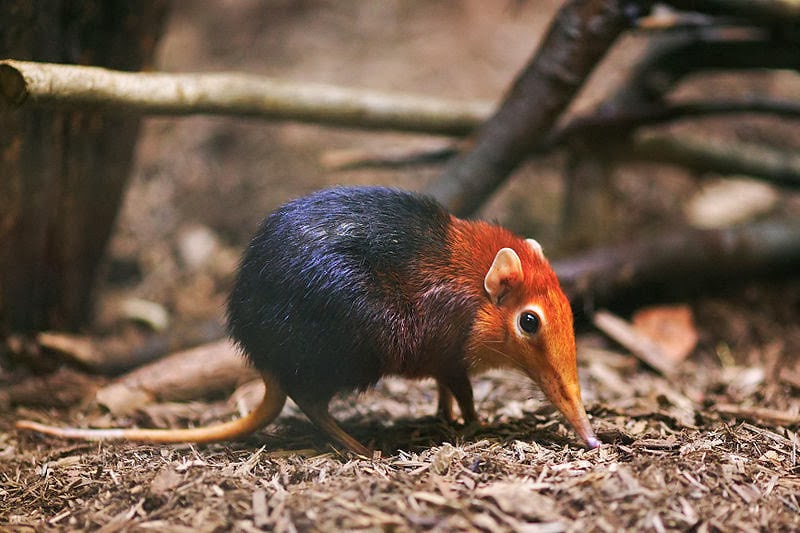
The cutest of the "Little 5", the Elephant Shrew is a small, insect
eating mammal with a long nose. Elephants Shrews are very common in
Southern Africa but seldom seen. They can grow up to 30 cm and have
relatively long legs which they use to hop about looking for food. Their
little trunks are quite flexible and can be twisted to sniff out
insects, which they then flick into their mouths using their tongues.
They've been known to leap almost 3 feet in a single bound. Elephants Shrews are not very social and often live in monogamous pairs. They mark
their territory with a strong scent produced by a gland under the tail.
Scientists have recently discovered the Elephant Shrew may actually be
more closely related to elephants than shrews.
The Buffalo Weaver bird can either refer to the common Black Buffalo
Weaver, or White-headed Buffalo Weaver. Both are found in dry areas and
are very common especially in East Africa. Out of all the Weavers, the
Buffalo Weaver is a messy nest-maker. Their large communal nests have
several side-entrances and are usually made of sticks and thorns. They
are among the largest of the weaver birds, measuring up to 24 cm. Their
diet consists of small and medium grass seed, small insects, and small
fruits. They are quite loud and social these birds, with a range of
cackles and calls.
We saw many of these flying around in Limpopo where they build their large nests in the huge baobab trees.
The Rhino Beetle is a large insect with ferocious looking body armor.
They belong to the scarab beetle family (Scarabaeidae). Rhino Beetles
can grow up to 2.5 inches long. Both sexes have similar body armor, but
only the males have a large horn (hence the name "rhino") which they use
in combat with other males. Rhino Beetles also use their horns to dig
for food inside rotting tree trunks, or undergrowth. They actually have
quite a varied diet, they'll eat rotting fruits, bark, sap and vegetable
matter. Rhino Beetles are among the strongest living creatures in the world
in proportion to their body weight. Rhino Beetle larvae can take up to
five years to mature into an adult. They can be found throughout Africa.
Leopard Tortoises all have unique and beautiful
markings on their shells, hence their name. They can be found throughout
sub-Saharan Africa, mostly in the drier, grassy areas of the continent.
Leopard Tortoises generally eat grasses, and this must suit them well
because they live up to 100 years. They generally do not burrow except
when building a nest for their eggs. They are good diggers though. Leopard Tortoises can reach up to 18 inches in
length and weigh up to 40 lbs. They are solitary animals.
We saw one crossing the road when I volunteered in Kariega in the Eastern Cape. Azel, our volunteer leader, stopped the land cruiser and picked him up for us to see before safely putting him (or her ... we weren't quite sure!) on his destination side of the road.
The Antlion is the smallest member of
the "Little 5" club, and in the US you may be more familiar with its
name "doodlebug". The Antlion is the larvae stage of a winged insect
that looks like a dragonfly. Antlions dig little conically shaped sand
traps in the ground to catch small ants, which they eat by basically
sucking them dry. They then toss out the dry carcass and wait for their
next victim. Not surprising then, they tend to live in sandy, arid areas
throughout Africa. The Antlion larvae has a wide body, large jaws and
apparently lacks an anus. It is a bit of a mystery as to why they are
called "Antlions", maybe because of their predatory nature.
We saw their sand traps on our walking safari in Mapungubwe. Our guide found one crawling around in the sand nearby and picked it up to show to us.
You know, I could be perfectly content to vacation on a beach somewhere hot and tropical with a beer or an umbrella adorned cocktail in one hand and a book in the other. A little shopping, a spa treatment or two and all my meals expertly prepared by somebody (anybody) else. But I had two sons. And every time I would suggest such a vacation, they would stare at me open-eyed and inquire, "yeah, but what are we going to do there?" So what we did or rather what they wanted us to do became the driving force behind our family vacations.
Crkey! It's a long way down into the glacier!
Zip-lining in the Costa Rican canopy, underground snorkeling in cenotes and cave rivers in the Yucatan, heli-skiing in British Columbia, ice-climbing on glaciers in Alaska and fly-fishing alongside bears catching salmon in the Brooks River.
with the bears of Katmai
And if that last one does not sound adventurous to you, let me tell you it most certainly is. As soon as the seaplane lands on the Katmai shore, you are greeted by a National Park Ranger at the waters' edge who instructs you on the way to behave when you encounter a bear on the lodge grounds, in the river when you're fly-fishing or on the hike from the lodge through the woods over to the observation platform.
Don't run!
Not if, but when. (Clap and make a lot of noise with your bear bells, slowly back up, and whatever you do, do not turn and run.)
And that is how I found myself on a boat speeding out of Mossel Bay towards shark-infested waters in order to climb into a steel cage and encounter great white sharks face to face. Yes I could have stayed back at the resort, had that cocktail and read that book but I never would have heard the end of it from my son and husband if I did.
And like most things I have done as a result of indulging my sons and husband, they end up being a ton of fun. It was a beautiful morning, the water was super warm and the shark sightings had been very good in the preceding days. We were in for some fun.
White Shark Africa came highly recommended by my friends at Kariega, all of whom survived their encounters with their limbs intact. And everyone who was on the boat with us that morning looked sane to me and non-suicidal. Ok, let's do it!
As soon as we dropped anchor and lowered the shark cage into the water, the crew started chumming. It didn't take long before several silhouettes started appearing in the water. Once some sharks were committed to the dance, the diving began. I climbed into the cage with only a snorkel mask on. The crew threw a large chum bait float on a rope into the water in front of us to attract the sharks and lure them over towards the cage.
The spotter yells either "down ahead" or "down left" or "down right" depending on where you should look and down you go under the water looking through your mask in that direction.
If you're lucky, you watch the shark swim at close range by the cage. If you're really lucky - or really unlucky depending on your level of nervousness - he crashes into the cage right at your face. Yes I was really lucky and let me tell you, it scared the freakin' crap out of me.
See?
I survived! And yet ...
Not without a little post-traumatic-shark-syndrome.
I cannot really describe the chilling feeling you get when you see the
shark grab the bait and do his death roll right in front of your face.
His
crooked teeth inches from your nose.
His cold steely eyes looking right at you while he does it.
My fellow Kariega volunteer Katy stopped over in Joburg on her way to her new adventure in the Kalahari. Katy is from the UK. She studied animal management at university there and has been working as a zookeeper for the past four years at Longleat Safari Park in Bath. If you don't know, Longleat House is the Elizabethan manor house presided over by the 7th Marquess of Bath.
In 1966, the 6th Marquess decided to turn the grounds of Longleat into England's first drive-through game reserve in order to attract tourism. It worked. We visited in 1996 when we took our sons to England for the first time. I think we even have a certificate somewhere in storage given to us by Longleat for completing their other major tourist attraction - to my boys anyway - their yew hedge maze.
When I met Katy in Kariega, she had just found out she had been accepted into a meerkat study program in the South Africa's Kgalagadi Transfrontier Park where Namibia, Botswana and South Africa come together. It is the ancestral home of the Bushman. We are so excited for Katy and so excited for us too. Now we have a friend there to visit when we go to the nearby Tswalu Desert Reserve!
What do you do with a zookeeper in Joburg? You visit the Johannesburg Zoo of course.
I made arrangements ahead of time with Alice, the Zoo's rhino keeper, for Katy to get up close and personal with the rhinos Pete and Zimbie and pet them.
Katy is overpowered by her springbok shank dinner at Moyo at Zoo Lake. (This one's for you Becky!)
I think I may have even convinced her to write a blog while she is there and share her experiences as the marchioness of meerkat manor. I know of at least 9 other people who would be interested in reading it. Best of luck for the next year Katy! See you soon.
The Johannesburg Zoo turned World Rhino Day on September 22 into an entire World Rhino Month for all of September.
We took the opportunity on Saturday to have breakfast with the Zoo's Rhino Keeper, Alice Masombuka and to hear first-hand about Alice's experiences being a rhino keeper at a Zoo. She is actually a pachyderm keeper and is also is responsible for the elephants and hippos at the Zoo.
Alice showed us an award-winning film about the famous Phila, a now seven year old black rhino who two years ago was shot nine times by poachers and still managed to miraculously survive! First she was darted from a helicopter with a tranquilizer to slow her down and then tracked and shot with two bullets by poachers on the ground. She managed to escape her attackers even though one of the bullets had shattered her foot.
Phila was rescued and brought to a nearby game preserve where she was prophylactically de-horned, treated and placed in a protected boma to recuperate and hopefully gain her strength back. A couple of months later she was shot an additional seven times at close range in the boma probably by the very same poachers. The theory is that the poachers did this as a senseless act of revenge because they were angry that she had escaped their grasp.
After being treated again for her grievous wounds, Phila lived at the more protected Johannesburg Zoo. Miraculously last year, she was released back into the wild in a secret location. She is doing amazingly well and now even has a male companion. She has not bred yet but everyone is hopeful she will be pregnant soon and will live a normal rhino life in peace.
We took a tour of the Zoo's pachyderm village and Alice introduced us to the two white rhinos who currently live at the Zoo, Peter and Zimbi. Not only were we taken inside the Rhino Enclosure to meet Peter and Zimbi, we were even allowed to pet them!
That's it! I signed up immediately to volunteer at the zoo to help Alice care for her rhino charges. Can't wait!
Alice gave us her insight on the state of the anti-poaching movement in South Africa and the different strategies they are employing to combat this scourge. We all gladly signed a petition urging the South African government and the international community to do more to save the rhinos.
with Alice
I should have spent the night because the next morning I was right back at the Zoo at 9:30 to participate in their Rhino March! I put my Kariega rhino tee shirt back on and my rhino "tears" earrings and necklace from Kisma & Co., grabbed a placard and joined the others who were marching to bring more awareness to the plight of the rhino.
The Rhino March was organized in cooperation with Rhino SA, another worthwhile animal conservation group in South Africa. Check out their website and write a letter to President Zuma. Tell him you want him to save the rhino before it is too late!
I came home to find that spring had already begun to sprung while I was in Kariega! Jasmine and camellia, lilies and clivias, azaleas and poppies were all blooming in my garden and it won't be long until the Blue Jacaranda is blooming too.
My two favorite blooming trees in South Africa have got to be the Coral Tree (Erythrina) and the Blue Jacaranda.
There are six species of Erythrina indigenous to South Africa, three of which flower from the late winter into spring. They were all over Kariega when we were there. The scarlet flowered common Coral Tree (Erythrina lysis tenon) and the ultra showy E. altissimo flower from late winter; the flame flowers of the Coast Coral Tree (E. caffra) appear about now.
The Blue Jacaranda (Jacaranda mimosifolia) is a sub-tropical tree known for its beautiful and long-lasting purplish-blue flowers. It is actually native to South America and it is considered somewhat of an invasive here, but that did not stop South Africans from planting millions of them in Gauteng.
Pretoria is popularly known as the Jacaranda City due to the enormous number of Jacaranda trees planted as street trees and in parks and gardens. In flowering time the city appears blue/purple in color when seen from nearby hills because of all their flowers. The time of year coincides with the year-end exams at the University of Pretoria and legend has it that if a flower from the Jacaranda tree drops on your head, you will pass all your exams. They must have a high graduation rate!
Joburg celebrates its Heritage Weekend in September to coincide with the start of the city's Jacaranda bloom and we will be taking advantage of some of the Heritage Foundation's walking tours to see them at their peak. And I have been waiting until bloom season to visit Pretoria to see if the city deserves its nickname.
Spring is in the air so go outside and check out the trees!
I finally feel like I live in South Africa. Sure I know I have been living here for months now, going to the food market and dentist, getting mail, driving on the left side of the road. Doing all the mundane everyday things that people do when they actually live somewhere. But I am not sure if I really felt like I was doing them "at home". I still thought of the US of A as home and had been feeling as if I was a character in a play about my life living in South Africa. But a board game in Kariega made me realize that I do indeed live in South Africa, that this is is not a play, and South Africa is now my home.
The game is called 30 Seconds and it is a combination of password, jeopardy and trivial pursuit. You play in teams and there are cards with five answers on them. People, places, things. You take turns reading the answers and trying to get your partner to guess as many answers on the card as they can in 30 seconds by giving them clues. You advance around the board on the number of right answers. For instance for London Bridge, you would say. "in the nursery rhyme I was 'falling down, falling down.'"
The version we played in Kariega was most definitely a South African version as a large percentage of the answers on the cards referred to obscure (to the outside world) South African people, places, and things. I played the game with a bunch of volunteers at Kariega who were definitely not South African. They all hailed from the UK with another American thrown in. Most of them did not recognize the South African references and could not come up with a clue to give their partner.
I would not have recognized them myself six months ago, but I found that I now knew practically all of the South African answers except for maybe the ones that referred to South African sports teams and players. (But I am not all that familiar with American sports teams and players either so that doesn't really count.) It made me realize I am feeling more South African or at least more "at home" in South Africa.
And while I probably still couldn't pass the South African citizenship test, I can play a mean 30 Seconds. That is something.
Even though it is still winter and many of the birds have not returned from their annual migration, we nonetheless managed to see quite a variety of birds over the past two weeks including the African Fish Eagle.


.jpg)




.JPG)

.JPG)