Friday, June 14, 2013

Beach Treasure

Growing up and summering in Wildwood Crest
My favorite place to be in the world is at the beach and I have always been lucky enough to live within an easy distance to an ocean and in the case of our beach houses, within walking distance. Until now.

Luckily South Africa itself has lots of beach being surrounded by the waters of two oceans, the Atlantic and the Indian, everywhere except along its northern border. Where I am. So I will have to work a little harder to get there ... but get there I will!


I love to swim and sail in salt water. I love the feel of sand between my toes and I love the smells and sounds of the ocean.

my boys & the green sand beach in Hawaii
 I also love to treasure hunt for shells, sea glass, pieces of coral, dried starfish and seahorses, driftwood, rocks and even interesting colored sand, all of which I collect. Volcanic black sand from Montserrat, olivine green sand from Hawaii, purple sand from Big Sur, coral pink sand from Bermuda. I have a sand collection (in storage) from some of my favorite beaches in the world. But before you think me completely mad, there is actually an International Sand Collectors Society. I do not belong to it but it exists. They have meetings and everything!
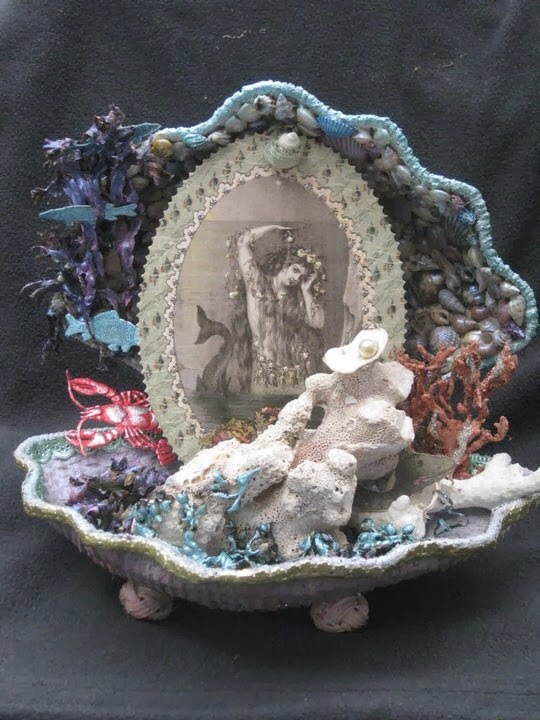
my mermaid grotto! It even lights up!


I put most of my treasures in bottles or seagrass baskets, framed them in shadowboxes or sat them on shelves or tabletops at the beach house. They were very decorative and looking at them would instantly take me back to a great memory or vacation.


Sirene, Stella Maris

Sometimes they became the inspiration for a craft project like this collage of a mermaid gazing at herself in her hand mirror made from shells, driftwood, seaweed, a skate case, and fan coral. My sister and I always had some beach project going at our beach house every summer! She is a very talented artist and I am a very agreeable assistant. Alas all our projects are in storage as well waiting for another beach house to decorate someday.


 In the meantime, the treasure-hunting tradition continues! When we were last in Cape Town, Vince and I came upon some interesting bean pods on the beach near Cape Agulhas. I brought one back to Joburg with me to dry and save. It is about 3 1/2 to 4 feet long! I did some research and found out they are sea bean pods from a river tree which grows mainly in East Africa and Mozambique called the Entada Gigas Creeper or the Monkey Ladder Tree.


Inside the pods, there are shiny brown seeds that can be round, rectangular and even heart-shaped. The seed has great value among African witchdoctors who use it in the divinatory ritual bone-throwing and other magical practices.


The Monkey Ladder tree is a type of drift seed plant. To propagate itself, this creeper drops its seeds into rivers which carry them down to the sea. Sometimes after years of travel, these seeds have been known to come in on the tide onto beaches as far south as Cape Point where is just where I found it!


The pod is so architectural and I love the warm brown color. I will hang it on the wall to remind my of the ocean while I am landlocked in Joburg. It will instantly take me back to the sea!


Thursday, June 13, 2013

Birds of a Feather

One of our favorite winter pastimes in NJ - especially after a blizzard would leave us snowed in and housebound - was birdwatching. We had a huge honeysuckle grove at the entrance to our conservatory which was home to a variety of birds who stayed north for the winter. Cardinals, woodpeckers, finches.

The honeysuckle provided shelter and nesting places and we provided a smorgasbord of birdfeeders and a heated fountain for water. We left our camera set up full time on its tripod and we enjoyed the quiet show. So we were anxious to see what lay outside our windows in the gardens at Valley Lodge.


The first bird you notice is the Hadeda Ibis. They are everywhere. They have a distinctive call (HA deda ... HA deda ... HA deda) which they like to do first thing in the morning. They are ubiquitous like our Canadian geese in the US except people actually like them here. They aerate the soil digging for earthworms and they are very popular on golf courses where they rid the grass of grubby pests. And they don't leave those gross deposits everywhere.


Serge prancing in a dog show

They are very large. About the size of a mini-dachshund I'd say. I was a little nervous for the puppies when I first saw them. Up on the rooftop they remind me of hawks surveying their dinner menu.


Lou doing Beach Yoga in Bay Head NJ


But they are more afraid of Lou and Serge than vice versa and they do not seem at all interested in carrying them off.


http://upload.wikimedia.org/wikipedia/commons/thumb/9/95/Eupodotis_afraoides_-Kalahari_Gemsbok_National_Park%2C_South_Africa-8.jpg/398px-Eupodotis_afraoides_-Kalahari_Gemsbok_National_Park%2C_South_Africa-8.jpg


I do like the style of this Northern Black Korhaan!


Then there is this yellow masked weaver who likes to perch on my car door and tap on the window. Cheeky little monkey!


But my favorite feathered neighbors at Valley Lodge are our resident rosy faced lovebirds. We have two of them of course and it always a joy to see them when I walk the puppies around the periphery. I must get a bird feeder for the garden to see if I can lure them in to visit my yard sometime. So pretty! 

The Bird Gardens at the nearby Montecasino entertainment complex house an aviary which I have read is the largest exhibit of its kind in all of Africa. I want to see it but I am waiting to go with my sister Cheryl when she visits - she is the true birder in the family. But in the meantime we have quite a collection just wandering around Valley Lodge to keep me entertained.

Wednesday, June 12, 2013

Nothing for Mahala

Whoo hoo! I was invited to my first film pre-screening as part of the Joburg press community!

It was for the soon to be released Nothing for Mahala directed by Rolie Nikowe. Brought to you by Quizzical in association with the award-winning multimedia NGO Heartlines, Nothing for Mahala is a film about a man whose love for money comes at a high cost. "Mahala" is South African slang for "free" so essentially the title means "There's no such thing as a free lunch." I will not give away any spoilers but will only say GO SEE IT! It is an entertaining and funny fable that has at its core an important life lesson for all of us. Money cannot buy happiness! It is scheduled to be released in Joburg in September. 

Heartlines was established by Dr. Garth Japhet who uses a values/moral lens through film and print stories to tackle society's big issues. His NGO Soul City communicates all aspects of public health, in particular HIV/AIDS through its namesake television series and has been shown to have had a significant impact especially with its targeted group, the youth. Nothing for Mahala is the first of Heartline's value-based feature films. They are in production right now for their second feature to promote a values and race-themed campaign.

Look for Nothing for Mahala in a theatre or at film festival near you!

The (Real) Great Wildebeest Migration

"The wildebeest begin their journey across the Mara River!" This post and photograph  just came across on my Facebook page. It is from the blog 50safaris and the photo was taken on their Great Migration Safari. 

The extraordinary annual Great Migration of wildebeest across the Serengeti-Mara ecosystem is one of the greatest spectacles in the natural world. Over one and a half million wildebeest partake in this journey! (To see all the day to day action from this safari, check out www.50safaris.wordpress.com. To join them on safari, head to their website for more details www.50safaris.com.)

It of course reminded me of the beginnings of my Great Wildebeest Migration which is how I originally dubbed a Facebook album and journal I started last summer which eventually became fodder for this blog. 

It was last year about this time in June that Vince began to talk in earnest about a possible international move. He had his sights set on somewhere in the Middle East, Qatar, Abu Dhabi or Dubai. I would wait a month to form my opinion on the subject. That July I had a trip to Ireland scheduled with my sister Cheryl and her daughter Jill. Jill planned to study Forensic Anthropology in Kells in County Meath and then to go to a riding camp at Castle Leslie in the border county of Monaghan. My sister and I went along for the ride adding on a weekend in Belfast and then north to Giant's Causeway in County Antrim and west to Counties Donegal and Sligo. 

We spent several days in Dublin where we were able to hook up with my dear friend Sheena. Sheena lives in Dublin - where she is from - in the summer and in Abu Dhabi during the school year. Her husband Alex has been working in Abu Dhabi for a number of years and their two sons attend the International School there. The last time I had seen Sheena was when she and Alex visited New York City a couple of years ago not long after the family had moved to Abu Dhabi. I was able to hear her first impressions of living in the Middle East then and I was anxious to hear how her feelings had evolved in the intervening two years.

We had a very frank chat about her life as a (female) expat in the Middle East one night over dinner in Dublin. She was very honest as I hoped she'd be. I found out that her opinion had not really improved much and I must admit I came away from our dinner a little less enthusiastic about the prospect of living there myself.

Fast forward a couple of weeks to early August 2012 when Vince presented the idea of basing our life in South Africa instead of the Middle East. After my conversation with Sheena, I considered it a much more attractive alternative and agreed almost immediately. It was soon after that when this photograph popped onto my Facebook page:


The photo is by Tim Lapage of Safari Experts, www.safariexperts.com. Tim had taken this photograph of the Great Wildebeest Migration from his airplane over the Serengeti. 

I had seen part of the migration myself in August of 1979 while on safari in Kenya and Tanzania. It was an awesome sight! One late afternoon we were even lucky enough to actually witness a cheetah kill. (Not so lucky for the wildebeest I admit but it is Africa and the circle of life as they say.) Two cheetahs brought down a wildebeest right before our very eyes. Our driver kept us in the game park well past the recommended time we were expected to leave to head back into camp. We were willing accomplices knowing this was an awesome sight we would probably never have the opportunity to witness again. We made it back to camp after dark and were severely chastised by our leaders but we knew we had been very lucky and we suffered the scolding gladly. It was like watching a National Geographic special in real time! 

Anyway, back to NJ in August 2012 ... I decided to begin a journal. I titled it The Great Wildebeest Migration after seeing Tom's post on Facebook and started recording the process of our migration to South Africa. It is hard to believe almost a year has gone by since then!

Our migration is not quite finished yet. I have just heard from the international shippers that the rest of our clothing and the few other pieces of chattel we shipped to South Africa is scheduled to arrive in the next week or so. I will surely blog about that experience very soon. Tomorrow I am going to the customs office south of Joburg to set up to receive our delivery! 

I would like to see the real Great Wildebeest Migration on safari again. But I think next time I would like to see it as Tim saw it, from high above the Serengeti in an airplane! Don't need to see another cheetah kill.


Monday, June 10, 2013

Mini-Size it Please!

Most food comes in very small packages in the supermarkets here. Even if you go to the Makro which is the South African equivalent of the American Sam's Club or Costco, it is impossible to find the same huge gargantuan containers for food. I spend a lot of time not unlike the Bushmen, hunting and gathering.

But as it turns out it is also a blessing in disguise. Things go bad so fast here. They must not use preservatives in food as much as American companies do. For instance a gallon of lactose-free milk from King's in NJ will last more than a month there. Seriously. Even after it is opened. A teeny container of lactose-free here, less than a week. If you open it, three days. I was bemoaning the small package sizes until I had to throw out my sour milk muesli breakfast this morning. Seriously.

Literary Guides

One of the things I like to do when I am planning a trip somewhere is to immerse myself in the place through reading. I sometimes use the fiction itself as guidebooks for specific places I want to visit in a country or region. Where was that hillside field in A Room with a View or the cave in A Passage to India?

And we were surely one of the first to blaze the Mayle Trail with our dog-eared and highlighted dummy copy of Peter Mayle's autobiographical A Year in Provence that our editor friend Dona gave us to read for our trip to the south of France before the book had even been published! The afternoon we spent lunching at L'Auberge de la Loube is still one of our favorite culinary memories.

I also like to read novels set in my destination while I am actually traveling there. It helps to keep you in the moment and fills the void while you are sitting on a train or ferry or waiting on line to get into a museum. I remember being on a train going through Germany reading The Eagle has Landed and being so consumed by the intrigue that when the conductor knocked on the car door to collect my ticket I jumped up half expecting him to be in the uniform of the Gestapo.

Bodmin Moor in Cornwall
England of course is the perfect literary guidebook destination. Being a huge fan of English literature anyway, I often travel there solely to visit the scenes in the books I love and once I get there I can simply reread the novels of Austen, the Bronte sisters and Du Maurier, Christie and EF Benson on the very grounds they immortalized in print.

But I especially like to read historical fiction. You get geography and history all in one package. James Michener is perfect for that. I read his Hawaii while in Hawaii and his Alaska in - you guessed it! One of my all-time favorite books is Michener's The Source which I read long before I went to Israel. It probably is single-handedly responsible for my fascination with archaeology. But I loved it even more when we actually visited Tel Megiddo which served as the book's inspiration while touring the Holy Land last October.

I was given a few books by knowing friends before I moved to South Africa such as The Fate of Africa and Mandela's A Long Walk to Freedom. And I just joined a book and movie club which concentrates on stories about and/or set in South Africa. But it was on an expat blog that I was reminded of the next book I plan to read. It is set in South Africa and written by none other than my favorite historical novelist James Michener. It is called The Covenant.

Amazon's synopsis is as follows, "Adventurers, scoundrels and missionaries. The best and worst of two continents carve an empire out of the vast wilderness that is to become South Africa. For hundreds of years, their rivalries and passions spill across the land. From the first Afrikaners to the powerful Zulu nation, and the missionaries who lived with both--all of them will influence and take part in the wars and politics that will change a nation forever."  Sounds good!

Continental Divide

Let's talk a little geography shall we? Geography was always one of my favorite subjects in grammar school. Continental divides, latitudes, longitudes, Tropics of Capricorn and Cancer, Tierra del Fuego and the Arctic Circle, states and capitals, elevation, rivers, tributaries, etc. I was a mental explorer long before I ever set out on foot.

Today we hiked in the Witwatersrand National Botanical Gardens and found out that Johannesburg, as well as the entire province of Gauteng where the city is located, sits on top of  the Witwatersrand range, a large sedimentary range of rocky hills of 1700 to 1800 meters above sea level. The Witwatersrand range forms a continental divide, an imaginary line which divides a land mass hydrologically and determines which way the rivers drain. Rivers to the north of the Witwatersrand such as the Crocodile River drains into the Limpopo River and Indian Ocean and  the run-off to the south drains into the Orange River and Atlantic Ocean.

Wyoming
What seemed odd to me about the Witwatersrand divide is that it runs east to west. I am more familiar with the Great Western Continental Divide of North and South America which runs north to south down the ridge of the Rocky Mountains into the Andes. We have visited high points in a number of US National Parks along the Rocky Mountains in Montana's Glacier, Wyoming's Yellowstone and Colorado's Rocky Mountain NPs. The Great Western Divide delineates whether a river runs into the Pacific (west) or Atlantic Ocean (east). That made more geographic sense to me.


I decided to do a little reading on the subject and found out that in addition to the Great Divide, the United States also has a series of east-west divides delineating run-off to Canada's Hudson Bay and Arctic Ocean to the north and the Gulf of Mexico and Atlantic to the south.

So it is the same with Africa.  The Witwatersrand is one of several divides throughout this massive continent, the most significant probably being the Congo-Nile Divide between the watersheds of the Nile which flows northward to the Mediterranean Sea and the Congo flowing south to the Atlantic Ocean.

But even though I must have failed the quiz about the USA east-west divides in grade school, I still maintain that I know the geography of North America pretty well. After Geography stopped being a core subject in school, I continued my studies on the ground. I have visited almost every state in the USA - except for Arkansas and Oklahoma - and most of the provinces of Canada.

Visits to National Parks have definitely been a big part of my geographic learning experience. We've been to hundreds of parks and preserves and in addition to the continental divide, we saw many of the unique geological features I had studied in books up close and personal on the ground there. From the Grand Tetons and the Great Smoky Mountains to the Mammoth Caves and Carlsbad Caverns, the Everglades and Congaree swamps to the Saguaro and Painted deserts, the Grand and Bryce Canyons to the Badlands and Tallgrass Prairies, the Katmai Peninsula, Channel and Virgin Islands to the Glacier and Biscayne Bays, the Mount Rainier, Haleakala and Hawaii Volcanoes to the Cuyahoga and Death Valleys, and from Meteor Crater to Crater Lake. It is a great way to learn your Geography lessons.

So now that I have moved to a new continent I have added Geography back into my curricula. I will read about the unique geological features of Africa for sure and study the maps and globes but I still plan to do most of my learning on the ground. It is just more fun that way!