Sunday, April 5, 2015

Holiday food is life!

One way that people like to celebrate their holidays is with food.

Easter 2012 menu from NY's Osteria del Circo
Back in the USA, the Christmas holiday meals we prepared over the course of the season were strongly influenced by our families' heritage. Seven fishes for an Italian Christmas Eve (me and Vince). German crown roast of pork on Christmas Day (Vince) and borscht and chicken Kiev for a Russian Epiphany (me again.)

Easter cuisine was kind of up for grabs. We would typically go out for brunch in NYC as our main meal of the day followed by a light supper later that night at home in NJ. Could be to a French restaurant, Italian, Greek or our old standby, the Russian Tea Room - any cuisine that includes a strong Easter menu. Thanksgiving was without fail an all-American turkey. And Independence Day? That would be a barbeque at the shore on the Fourth of July.

If we were traveling during the Christmas or Easter holidays, we would naturally check out the local customs and fare. Like oysters for a French réveillon on New Year's Eve. Last year we were in Mozambique for Easter so Easter lunch consisted of king prawns straight off the fishing boats!

An Easter supper in our NJ dining room
... and another Easter supper in our NJ kitchen
This year for Easter we stayed put in Joburg. We had Easter Sunday lunch at Mosaic with Eat Out Chef of the Year Chantel Dartnall at the Orient Boutique Hotel in Pretoria. But before that, we indulged in some traditional South African Easter dishes which we made at home.

First on Good Friday, our one meal of the day was poached kingklip. Along with Ash Wednesday, Good Friday for Catholics is a day of abstinence which means in addition to being meatless, it is also limited to only one full meal for the whole day.

After our Good Friday dinner, we prepared pickled fish from the leftovers for Holy Saturday's dinner. The suggestion and recipe for this Cape Malay Easter classic came from a blog called Scrumptious South Africa.  Award-winning social media strategist, cook, food writer, recipe developer, professional freelance journalist, editor and blogger Jane-Anne Hobbs Rayner (that's alot of hats!) also included a bonus fish paté recipe for the leftovers from the pickled fish dish. This recipe keeps on giving!

Eating pickled fish is a South African Easter tradition. Celebrated Cape Malay cookbook author and chef Cass Abrahams, of German and Xhosa extraction, was raised as a Christian in Johannesburg and converted to Islam when she married into the Cape Malay community. Growing up, her Christian family would eat pickled fish and hot cross buns for breakfast on Good Friday before going to a prayer service - a very long one in the Johannesburg City Hall - and have the same afterwards. Pickled fish with hot cross buns? Abrahams believes this cross-cultural tradition started in Cape Town's District Six where Muslims, Jews and Catholics once lived closely side by side.

On Easter morning we broke our fast with Jane-Anne's Hot Cross Buns Bread and Butter Pudding with Pears. It is an excellent way to use up those left-over Good Friday hot cross buns and it was delicious!

Why did I never think of using hot cross buns this way? It reminded me of Craig Claiborne's Egg Nog Challah French Toast recipe (NYT Cookbook, 1992) which we make every year on Christmas morning!

Of course the best part of making holiday foods from heritage recipes other than your own or eating the local food of a country you visit or live in during a holiday is that the food then becomes a part of your holiday tradition. We can make this hot cross bun recipe every Easter morning from now on and harken back to our first Easter breakfast in South Africa. And we will.


Mexican Hot Chocolate from Azteca
Hot Cross Buns Bread and Butter Pudding with Pears and a Caramel Amarula Sauce
Amarula Hot Chocolate with an elephant Peep and choco-rhinos!
"glub!"
elephant Peep eye!
And after Easter ...

Easter Monday egg salad and ham hot cross bun sliders
pickled fish pate and beetroot hummus on baguette slices

Happy Ndebele Easter from Valley Lodge!

Thanks Heather for my awesome Ndebele Easter table runner!


Joyce's, my and Esther's Ndebele Pysanky
A Ndebele Easter calls for Ndebele Pysanky. The one on the left was made by Joyce Ndimande, daughter of Francine. The one on the right by Esther Mahlangu and the (comparatively sad) one in the middle was made by moi!


Vince's Easter "basket" for me - a boiled wool vase!

chocolate dung and a tin can lion
safari animal wine charms, beaded dessert forks, sardine run paper clips and trophy key hangers
Cadbury creme eggs, marzipan, and candy animal paws
choco-rhinos and painted eggs
safari Peeps!

Saturday, April 4, 2015

Melville Koppies with Lou & Serge

Eish!
Melville Koppies is a Nature Reserve and a Johannesburg City Heritage Site. It is the last conserved remnant of Johannesburg's ridges as they were before the discovery of gold in 1886.

Its geology goes back three billion years and recovered stone tools show that Early Stone Age man camped here as long as 500,000 years ago. There is a Late Stone Age living floor and within the last 1000 years Iron Age immigrants arrived. Remains of their kraal walls can be found on the northern slopes. In 1963 an iron-smelting furnace was excavated and can be seen today.

A "koppie" is Afrikaans for "a small hill." The word derives from the Dutch "kopje" which means literally "a little head." The vegetation of the Koppies is entirely indigenous and is a remarkable example of the richness of highveld grasses, flowers, and trees so close to a city centre. These ridges have looked like this for hundreds of years.

Socialized dogs on leads are welcome on Melville Koppies West and East, but not allowed on Melville Koppies Central because of the archaeological significance. In fact there are organized guided dog walks through Melville Koppies West every first Saturday of the month. Lou & Serge are very social so we decided to join the group for a walk on Saturday.

The group meets at 8:00 sharp at the 3rd Avenue and Arundel Road entrance to the Reserve in Westdene. And even though it was a holiday weekend which meant that probably many people were away, it was still quite well-attended. Make a small donation to the Friends of the Melville Koppies and you are off.

We climbed up the koppie to the top of the ridge over some pretty tough terrain for our poor heroes Lou & Serge. They are low-riders after all with very short legs! The group keeps a pretty brisk pace and their 5K walk usually last between an hour and 90 minutes.

From the get-go, Lou struggled to keep up. He finally declared the end of his jurisdiction by sitting down in the grass and refusing to get up until we turned around. Which we did.

Lou pulling up the rear!

in their defense, it was more like running the gauntlet than walking

over boulders

if it wasn't the boulders, it was the tall grass

disappearing dogs
But the views were spectacular!

overlooking Joburg

with some interesting vegetation

After our walk, we rewarded ourselves with a stop at the Bamboo Market in downtown Melville for some goodies.

Afterwards we drove back to Valley Lodge where Vince gave Lou & Serge a good brushing to remove all the burrs they picked up in the tall grass. Then it was nap time for these two tuckered out koppie explorers!


Making a Silkscreen Ndebele Table Runner

Heather is an American expat who lives in South Africa and Dubai. She invited me to her studio in Parkhurst for an impromptu workshop to teach me how to silkscreen a table runner to go along with my Ndebele Easter table.
Heather is an international artist, primarily a printmaker. Her husband has always traveled alot for work and for a while Heather traveled with him all over South America. Eventually they moved to Dubai when his work brought him to northern and western Africa for long periods of time. And then to South Africa when his work shifted to southern Africa.

As an artist, Heather is lucky that she can create her art in all of these locations and her esthetic has expanded by intimate exposure to the diverse cultures she has encountered living and traveling abroad.

I chose a Ndebele design to go along with my Easter theme and decided to decorate a table runner. Let me just say right up front that my admiration for the silk screen artist has catapulted to extreme adoration since trying to do it myself. It takes patience, obsessive compulsive cleanliness, and meticulous attention to detail ... none of which I possess. It is a craft with very little forgiveness or margin for error. I need a lot of leeway!

That - coupled with the fact that as an afterthought Heather said I probably chose a project that was way more advanced that the typical "beginner" project - meant that I did get to make just about every mistake there is to make. And you know what they say, "Failure is instructive." I learned a lot over the two days I spent making my runner with Heather.

Heather is a very good teacher. For one thing she made me do everything myself. From drawing and cutting out my stencils, choosing my colors and design placement, to actually silk-screening and painting the fabric. She gave her instructions laced with good practice skills gleaned from years of experience and training. No short-cuts. (That's the other thing ... I love short-cuts! Bad for silk-screening though.)

I used two designs for my runner. A Ndebele church and a painted door inspired by my Africa Meets Africa book. So two designs equals four stencils, two for each design. One each for the main shapes and one for their respective outlines. Using transparencies, sharpie pens and an x-acto knife, I first made the stencils. Heather had all the screens, paintbrushes, paints, and squeegees I needed to silkscreen six churches and four doors onto my white cotton runner.

first printing!


aqua, orange, sky blue, red, yellow, and violet

the church with the black outline overlay

next, add the door stencils

violet, yellow, sky blue and orange doors

letting it dry after some touch-ups
After the paint was completely dry, I set the prints with brown paper and an iron. Finally my table runner was ready for Easter morning at Valley Lodge!

Thursday, April 2, 2015

Galagos

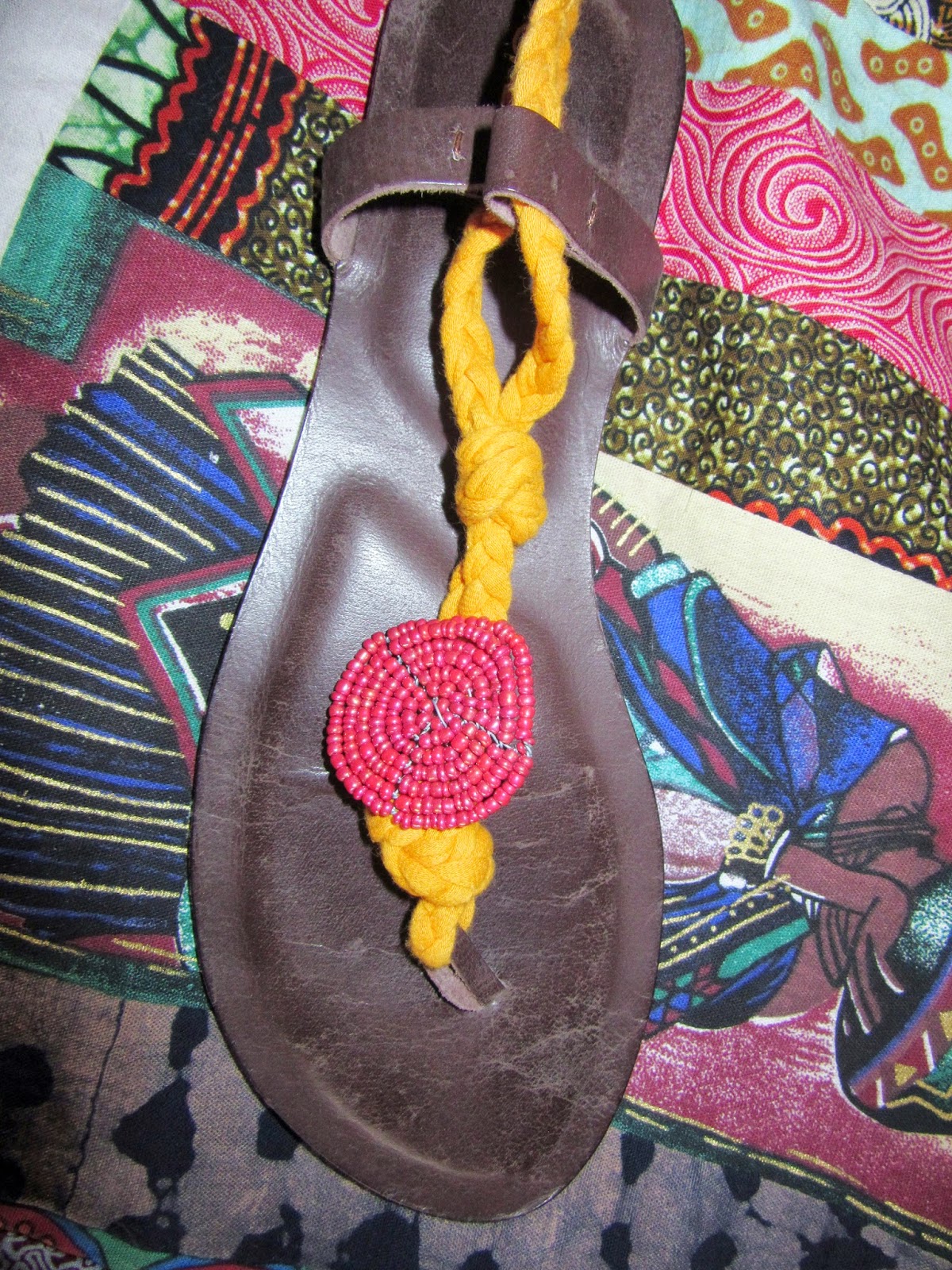
So I bought this pair of sandals a couple of months ago in the big red barn market at the V&A in Cape Town. It's not just a pair of sandals. It's more like a sandal "system." You see, you buy a single pair of soles and you can mix and match any one of a number of straps and decorations to custom-make your sandals.

They are very practical really. Vince is always complaining that I bring too many shoes with me on vacation. I once brought five pairs of shoes for a long weekend in Martha's Vineyard and I bought another pair while I was at it in Edgartown!  Okay, I see his point. With this system, you can pack one set of soles and multiple straps instead of multiple pairs of complete sandals, thereby saving some suitcase space without giving up fashion flexibility. Worth a try.

I bought these bright yellow ropey straps and these red beaded circle pins to go with my soles in Cape Town. They sold the ropes in a variety of colors and there were also a slew of decorative pins I could have chosen. But I had a particular outfit in mind which is why I originally chose yellow and red. I figured I could buy additional straps when I want to change them to go with another outfit in the future.

But did I mention that I bought them in Cape Town? So if I decide at the last minute I want to change the straps to go with something I want to wear in Joburg, I'm screwed. Until now. I just found that African Queen, my go-to shop at the Benmore Shopping Center, also carries Galago sandals and straps. Back in business!


I just bought a new set of leather straps at African Queen which I want to wear this weekend. So it is important that I remember how the salesgirl originally put these ropes on in Cape Town in order for me to do it again when I want to change them back.

Okay, here's how it goes, First she put the rope half way through the toe loop so that the ends were even..

Then she tied a knot right under the loop.

She tied a second knot about two inches down, leaving enough space to pin on the bead decoration pin. Then she put the ends through each side loop.

To wear them, you just tie the ropes around your ankles espadrille-style. You could throw in a couple more knots or tie it up in a bow. Whatever.

My new strap set is all leather. A side strap, a toe strap and an optional front piece. You can mix and match the colors and finishes on these pieces as well. Too many choices! I chose a brown faux ostrich toe strap, a smooth white front piece and a smooth black side strap.

The toe strap uses a button to attach it to the toe loop.


The side strap and the toe strap go through the optional front piece. You just put the side straps through the side loops, ...


... buckle it in the back and I am good to Galago-go-go! Where we going?

I got my postcard!

Anytime I get actual mail delivered to my post office box in Benmore is cause for celebration. And today, my Blue Train postcard arrived! Woo hoo!

Let's see, I wrote it on March 11 and I am sure our compartment butler Liphert mailed it promptly on March 12. So that would make it 23 days or approximately three weeks for it to travel from Cape Town to Sandton. In TIA Africa, that would equate to a pitch perfect performance! (Really, I was just hoping to get it by our real birthdays in another month!)

Well done Post Office!

Hot Cross Buns

There may be a severe lack of Peeps and malted milk robin's eggs for Easter in South Africa, but they sure make up for it with their Good Friday Hot Cross Buns!

The practice of eating special small cakes at the time of the Spring festival seems to date back at least to the ancient Greeks. When archaeologists excavated the ancient Italian city of Herculaneum near Pompeii, which had been buried under volcanic ask and lava since 79 C.E., they found two small loaves, each with a cross on it, among the ruins. I remember that exhibit!

"The English custom of eating spiced buns on Good Friday was perhaps institutionalized in Tudor times, when a London bylaw was introduced forbidding the sale of such buns except on Good Friday, at Christmas, and at burials.

The first intimation we have of a cross appearing on the bun, in remembrance of Christ's cross, comes in Poor Robin's Almanack (1733): Good Friday comes this month, the old woman runs, with one or two a penny hot cross buns' (a version of the once familiar street-cry "One-a-penny, two-a penny, hot cross buns'). At this stage the cross was presumably simply incised with a knife, rather than piped on in pastry, as is the modern commercial practice. As yet, too, the name of such buns was just cross buns: James Boswell recorded in his Life of Johnson (1791): 9 Apr. An. 1773, 'Being Good Friday I breakfasted with him and cross-buns.' The fact that they were generally sold hot, however, seems to have led by the early nineteenth century to the incorporation of hot into their name."
      ---An A-Z of Food & Drink, John Ayto [Oxford University Press:Oxford] 2002 (p. 164)

I only remember seeing the traditional hot cross bun for sale in bakeries and markets in the USA. They were all yeasty fluffy spicy bread buns with currants inside and a drizzled icing on top in the shape of the cross. I thought that was the end of the story.

apparently English hot cross buns are not traditional in SA
Not here in South Africa. At Woolies yesterday, I saw extra spicy hot cross buns, white chocolate and apricot hot cross buns, chocolate and Amarena cherry hot cross buns, sticky date and caramel hot cross buns, chocolate and caramel hot cross buns, traditional hot cross buns and English hot cross buns (not sure what the difference is between those last two!) They even had fruitless hot cross buns which I think are just called "bread."

South Africa. Getting freaky with the Hot Cross Bun.